SOURCE:
The Best Mask Study Yet ⋆ Brownstone Institute
School masking has undoubtedly been one of the COVID’s most infuriating issues.
The case for masking by the general public has quite obviously always been weak, considering there was no pre-pandemic planning that suggested masking would ever be beneficial.
But the case to mask children has always been significantly worse.
Even Professor Francois Balloux, a self-described COVID “centrist,” who is rarely prone to extreme declarations or hyperbole, admitted recently that the masking of young children is “the most bizarre public health policy ever:”
There is obviously a tremendous amount of research and data proving that mask mandates are ineffective, especially in schools.
Yet the policy continues in many parts of the country.
Just recently, a number of locations in California brought back forced school masking:
But a new study out provides some important new evidence with regards to the efficacy of mask mandates.
The Study Design
The study authors included several credentialed experts like Tracy Høeg and USC’s Neeraj Sood, along with one extremely qualified data analyst, Josh Stevenson.
You may know Josh from his fantastic work on Twitter as well as Substack, and this study could very well be his most important contribution yet.
Their detailed examination of North Dakota has created more advanced academic level research similar to the data comparisons that myself and many others have shared.
The introduction explains the methodology and goals:
School districts across the nation have implemented mask mandates for children in the hope of reducing COVID-19 transmission, but the impact of school-based mask mandates on COVID-19 transmission in children is not fully established. While observational studies of school mask mandates have had conflicting results, randomized studies have failed to detect an impact of masking on participants under 50 years of age [1-6]. Here we report the results of a natural experiment in two large K-12 school districts in Fargo, North Dakota, Fargo Public Schools (FPS) and West Fargo Public Schools (WF), to estimate the association between school mask mandates and COVID-19 infections. Our study population is unique because the districts are adjacent to each other in the same county and have similar student demographics, COVID-19 mitigation policies and staff vaccination rates. At the start of the Fall 2021 semester, FPS mandated masks and WF did not. On January 17, 2022, FPS also moved to a mask optional policy, creating a unique natural experiment to study school-based mask mandates.
While not a purely randomized controlled trial, this is about as good of a natural experiment as you’re going to get.
We have two similar populations, with similar vaccination rates and demographics that are quite literally right next to each other.
The data table explaining the comparison shows how similar their mitigation policies, student populations and faculty vaccination rates were during the time period examined.
Below is the first part of the breakdown:
Table 1: School district characteristics and COVID-19 risk mitigation measures in Fall 2021 in study school districts
Both schools had essentially identical racial/ethnic breakdowns and staff vaccination rates (74.5% and 77.6%).
Non-mask “mitigation” policies were also extremely similar:
So with all that in mind, it’s important to revisit the time frame for the different masking policies.
When the Fall 2021 semester started on August 26th, Fargo Schools did have a mask mandate, West Fargo Public Schools did not.
As previously explained, all other policies were similar as were the student population demographics.
With all that said, what were the results?
First, let’s examine the trends for both districts, without labels:
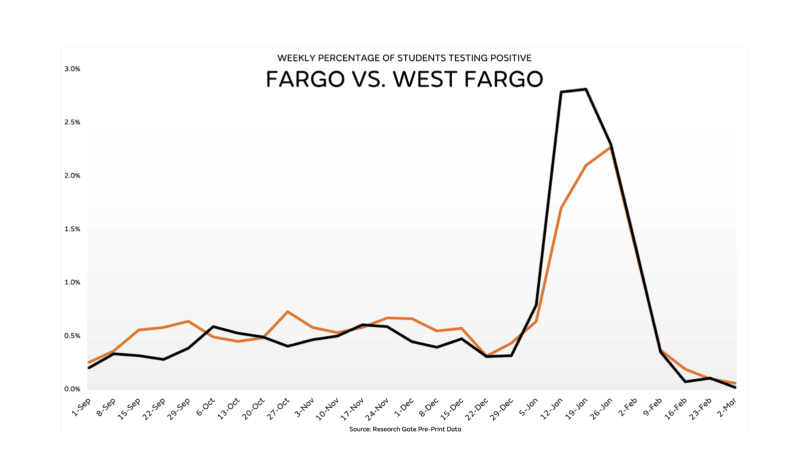
Can you guess which district had the mask mandate policy until January 17th?
The Results
By now it should not come as much of a surprise, but the black line represents the district with the mask mandate.
That’s correct, the mask mandate schools had a higher peak during winter than those that were optional.
The lack of impact is even more visible when the labels are added back in:
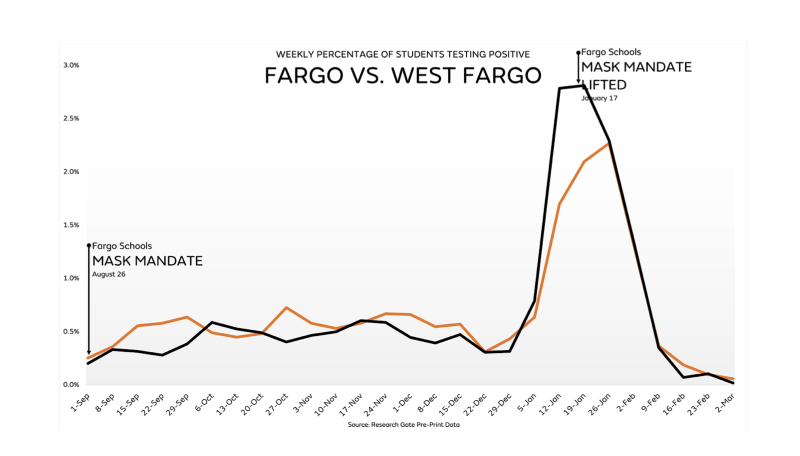
Throughout the fall semester and into January, the cumulative incidence rates were nearly identical.
13.0% of West Fargo students tested positive, and 12.9% of Fargo students tested positive:
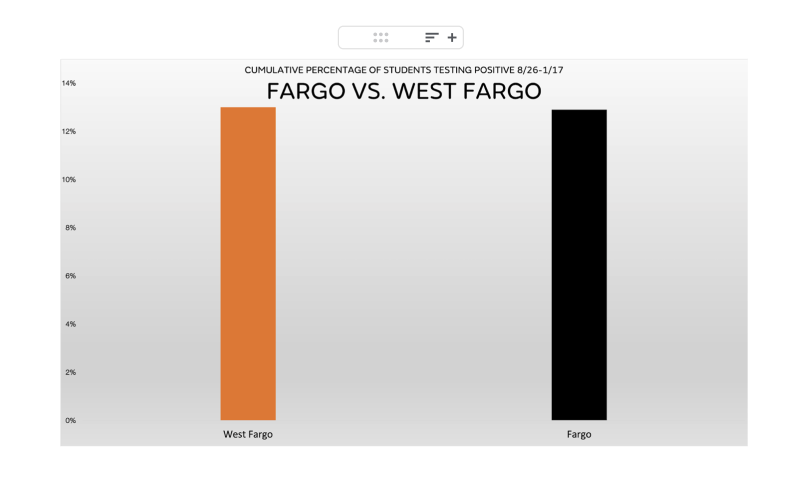
There was no statistically significant benefit to mandating masks in schools, in a comparison between two school districts located right next to each other, sharing very similar population demographics and secondary mitigation policies.
As if we needed more evidence that mask mandates do not work.
Another common argument by the pro-mask fanatics is that arguing that mandates are ineffective misses the point, because mandates do not necessarily mean compliance.
Well, the study authors thought about that too.
While they weren’t able to specifically measure compliance, they personally communicated with parents and local administrators to get a sense of how many students were actually wearing masks.
And as with basically everywhere else, when masks are mandated, people generally comply:
We also did not have data on the types of masks being worn or on masking adherence rates in the two school districts; however, parents and administrators indicated via personal communication with SH, masking was near universal in the district with a mask mandate and 5% or less in the masks-optional district.
Only a maximum of 5% of students in West Fargo schools were wearing masks of their own volition, while Fargo achieved “near universal” compliance.
It didn’t matter.
If you’re wondering how that could be possible, it’s because masks don’t work.
Mandates never work or demonstrate any significant benefits because they’re forcing compliance with a useless facial decoration, to borrow Leana Wen’s colorful description.
The Confirmation
Fargo Schools, beyond providing additional data to illustrate clearly that masks and mandates are ineffective, also helped validate the results by moving to a mask optional policy in January 2021.
This provided an opportunity to measure nearly two months of data when both districts had the same mask wearing rules.
And once again, the results were the same.
5.1% of West Fargo students tested positive, and 5.3% of Fargo students tested positive.
No matter what, there’s very little difference.
This indicates that the pairing is very well matched, confirming that mandate policies are completely irrelevant.
There was no surge in Fargo schools after the mandate was lifted, nor did West Fargo experience a prolonged peak due to their mask optional policy before the winter/Omicron increases.
It just didn’t matter. It’s hard to believe that there are people out there who still believe that masks work and mandates should be implemented.
It’s even harder still to believe that those people also want to inflict their harmful delusions onto children, who should have been protected by adults.
No matter how large the evidence base gets, no matter how much research is conducted, it will never be enough for huge segments of the population.
But for those willing to be convinced, for school administrators who aren’t sure how to handle the inevitable fall and winter surge this year, this study provides yet another valuable contribution to the case against mandates.
